.jpeg.03d9e28d8a0d71e8411854369a9f9b91.jpeg)


Adil
-
Posts
187 -
Joined
-
Last visited
Everything posted by Adil
-
From this basho, mbovo's stream has English commentary. Is there any way to watch the entire makuuchi broadcast with Japanese commentary (viz., the way mbovo used to have it on Twitch before)?
-
Thanks a bunch for your great work, mbovo. Much appreciated. Your stream on Twitch is my main source for watching sumo. From this basho, as you have mentioned, the commentary is in English, which is great news for some fans. I prefer to watch sumo with Japanese commentary. Are there any other sources where I can watch the entire makuuchi broadcast with Japanese commentary? Thanks again for your great work.
-
Haha! I was about to ask if I heard that correctly, but you answered it already. When the interviewer said 途中凄い張り手でしたね (That was a great slap in the middle [of the match], wasn't it?)、Shouhouzan replied そうですね、まああまりよくないですけど (That's right... It's not a good thing, though.). My question: Are harite frowned upon? If so, why does Shouhouzan use them all the time? I also remember Harumafuji being warned about using harite too much during keiko (or was that jungyou?); the oyakata who spoke about it was quoted in the newspapers as saying 'Sumou is not brawling'. Would a rikishi who uses harite too much be considered to be doing something 'wrong'? It is definitely legal, but judging from what Shouhouzan said during the interview, there seems to be a level of, oh I don't know, reluctance (for lack of a better term) about using it too much.
-
Tokushouryuu said in his interview (among other things) that he had contemplated the possibility of being demoted to makushita; he started crying and couldn't continue the interview after saying that. Is his yusho interview available anywhere? https://www3.nhk.or.jp/news/html/20180923/k10011641441000.html?utm_int=word_contents_list-items_004&word_result=大相撲
-
Thanks!! Damn, I ran out of likes.
-
Is there a video of today's kesho mawashi close-ups? Does it happen only once a basho?
-
Thanks for the great pics, Akinomaki! A bit of an off-topic question: I will be in Japan from 12 June to 27 June. I was really hoping to plan my trip such that I would be able to watch at least a few days of the Nagoya basho, but alas! It's not to be. Is there, by any chance, an event or something where I could watch sumo during my trip? The only sumo related activities that I have planned so far are just trips to the sumo museum and watching asa-geiko through the windows at Arashio Beya.
-
I like Ichinojo as much as the next guy and I have been waiting (like most of the folks here) for him to wake up from his torpor after that meteoric rise, but I am starting to get the feeling he won't go too far. I don't think his body can take that much pounding - no, I am not talking about his opponents; I am talking about his own weight. Has there been a 200 kg+ rikishi in recent times who had a long, successful career as an ozeki/sanyaku mainstay? The three Hawaiian behemoths come to mind, but Musashimaru and Konishiki became ozeki at the age of 23 and 24 respectively and Akebono was yokozuna at the age of 24. (Anyway, the three Hawaiians are more like the exception than the rule.) Ichinojo will be 25 in three months; if he becomes ozeki in 2018, one could say that his rise to the top is roughly in the same timeframe as the three Hawaiians. If not, father time will start catching up with him real fast. If he becomes ozeki soon, he can start playing the kyujo/kadoban game to let his body recuperate. In that case, I guess he can have a long, successful career as an ozeki and maybe even become yokozuna. If he doesn't become ozeki soon and he keeps posting the kinds of results that he has been doing for the last three years (no double-digit wins in 2015, one in 2016 from M11 and one in 2017 from M4) in 2018, his chances of becoming an ozeki will go down real fast as his body starts breaking down because of the stress of having to compete in each and every basho. Summary: If he doesn't become ozeki in 2018 or early 2019 while he still appears to be in good shape, he's not going to make it because his weight and body shape will affect his knees and back very much.
-
I've been meaning to comment on this for a few months now, but I've just been so damn busy. Plus, I have this bad habit of letting my posts ramble on for hundreds of words when I intend to make a two sentence comment. Oh gosh, looks like I'm going to do it again! Some time during the last year (I've forgotten the exact time, but it appeared to happen overnight), Takayasu fine-tuned his tachiai. It is no longer the usual get up and charge. The trajectory of his charge is more vertical than horizontal, and he accentuates that by giving an upwards and backwards shove with both arms after slamming into his aite. The effect on his aite is a thing of beauty to watch. I have been amazed at the terrific impact and how it knocks the opponents back because of the sheer power and technique. Even the 200+ KG Ichinojo felt the power of that tachiai and he was knocked back a bit. To the untrained eye (myself included), sumo looks a sport that relies solely on brute strength, with two massive individuals trying to knock each other over with random shoves and throws, but things like Takayasu's new tachiai show the importance of technique. Everybody can throw a punch, but I remember reading the early 20th century boxing legend and world champion Jack Dempsey's book in which he goes into great detail on how to generate power in a punch to knock a guy out. I wouldn't have known how much thought and perfectionism goes into something that appears to be so simple. Anyway, I can't be the only one who has noticed his new tachiai and its effect, so I am guessing other rikishi will start to use techniques to neutralize it, but I will enjoy it while it lasts. Incidentally, I just remembered that Takayasu's new tachiai looks similar to Chiyotairyu's wild jump-into-the-swimming-pool lunges during bouts, except Takayasu's tachiai appears to be more controlled. When Chiyotairyu connects one of his lunges (for lack of a better word), it is usually curtains for his aite, but because it is very difficult not to telegraph it, it is sometimes easy for Chiyotairyu's opponents to counter it. I am now ending my post, trying to pretend to myself that I didn't do what I was afraid I will end up doing.
-
Is there a repository/collection of high resolution kesho mawashi pics on the internet? This is a great thread to see them, but I am wondering if there is a website that lists all the kesho-mawashi on one page and then I could click and view whichever one I want.
-
Loved the chess match between Hakuho and Ichinojo. I noticed that Hakuho broke Ichinojo's left hand grip almost exactly the way he did against Harumafuji in Natsu 17: My hopes of Osunaarashi becoming a top rikishi in makuuchi have been going down steadily over the years because of all his injuries. It was almost too painful to see him today after his victory as he stood by the dohyo waiting to give the chikaramizu to the rikishi getting ready for the next match. He appeared to be in incredible pain. He could barely lift his right hand to even take the chikaramizu ladle from the yobidashi. Even though he's not one the glamorous rikishi (Ha! For some reason I just remembered the 1980s WWF tag team, The Glamour Girls), the thing I love about Takarafuji is that he fights very intelligently. He must study his opponents very closely because I have noticed that he always makes it very difficult for his opponent to employ his signature style, whatever it may be. Notice how he didn't let Chiyomaru use his signature 'extend-both-arms-and-instant-pull+extend-both-arms-and-instant-pull' today. He also makes it difficult for his opponents to get to his belt. I am now ready to take my bets off Osunaarashi and Chiyootori and place them on Hokutofuji. I love watching his matches. Here's looking forward to a career that isn't plagued too much by debilitating injuries (it's useless to hope for an injury-free career in sumo). Speaking of which, the thing that I have started to admire the most about Hakuho is his ability to limit the effect of injuries on his career. The dude has been at the very top for a long time and he still looks so sharp, although I've been reading for years on this forum that 'Oh, he's way past his prime and he'll retire at the end of this year'. Well, I'm a sumo noob who only started watching in 2012 and maybe he is past his prime, but to think that he can still be the top dog in pretty much each and every basho that he competes in even ten years after his promotion to the rank of yokozuna is amazing. To put this in perspective, look at how some of the others at the top of the current banzuke have fared with injuries: Harumafuji (injury department store with knees, elbows and ankles gone) Kakuryu (one tournament completed this whole year) Kisenosato (hasn't completed a tournament since his promotion and looks like a wreck even when he does compete) Terunofuji (his career at the top was effectively ended after that devastating knee injury against the aforementioned Kisenosato) Kotoshogiku (his once formidable gaburi yoris are not what they used to be) Yes, I am starting to believe that the number one factor that makes Hakuho one of the greatest of all time (sorry Konishiki, but you don't know what you are talking about when you say Hakuho might not even be an ozeki in your day) is his ability to adapt his style in a way that allows him to be an unstoppable force at a time in his career when many top rikishi become so broken down that there's no place for them to go but down the banzuke. Damn! When I started this message, I was planning to write only two lines. Sheesh!
-
I see.... I never watch the English stream / digest, so I didn't know.
-
I just saw John Gunning's name as one of the three English announcers on the Japanese feed. Is this his first time? In any case, this is major news and congrats to Gunning-san.
-
I agree that he doesn't look like a real powerhouse. That's why I was surprised when I read a post here on the forum a couple of years. It quoted Isegahama oyakata as saying that Takarafuji is incredibly strong and that he can bench press some crazy weights. Come to think of it, could it be I mistook a quote about Terunofuji?
-
Saw this graphic during the broadcast. It says something about different kimarite. I can only make out some of them, like okuritsuridashi, which are rarely (if ever) seen during honbasho. Were they talking about the rarest kimarite or something?

-
Haha! Good one.
-
It's a bummer about Hideyoshi. So I guess the Japanese in taiga isn't as archaic / non-standard as I thought after reading those other forums I mentioned in my first post.
-
I have started working on learning Japanese and one of the things I was excited about was watching taiga dramas. History being my passion, I was overjoyed at finding a wealth of historical dramas and I have been watching 'Nobunaga' so far. I understand that it is historical fiction and all that, but that doesn't concern me as I don't trust anything other than original sources anyway. The historical accuracy bit is a different issue and it is not the topic of this thread. What I am interested in is to get some feedback from forum members who speak Japanese about the language used in the taiga. I read in another forum somewhere that it is a bad idea to watch taiga for the purpose of improving your Japanese because the language has been deliberately archaized to give it an old feel. It said that even the Japanese people themselves have a hard time understanding that kind of Japanese and you would sound funny if you spoke like that. What is your take on that? I did notice some peculiarities, such as every other sentence finishing in 'gozare maseru' and people referring to themselves with their own names (This Nobunaga is very happy / This Kicho asks your permission). I don't know if these were the polite forms of speaking Japanese or just the production team's way of making the language sound more 'historical' or court-related. Should I completely disregard the language and watch the dramas just for the content? Come to think of it, I could ignore the grammar and focus more on words. I have already started picking up words and there [Your father says you are his 'takara' (treasure) / We have to defend the 'shiro' (castle)]. EDIT: Another point: I was planning on watching 'Hideyoshi' after I finish 'Nobunaga', but unfortunately, it doesn't have English subs. I found a website where one could find subs for some of the Taiga, but Hideyoshi is not there. Does anyone know of a website where they could be available?
-
Some amazing athletes there with great movement and techniques. There were many magic moments in there, but the highlight has to be the nage no uchi ai at 21:47. Both rikishi (is that the right word for a female sumotori?) are willing to take a very painful fall instead of putting a hand down. Will look around for more competitions like this one.
-
As Kuroyama and Asojima have pointed out, that was a mistake from me. I have corrected it now.
-
Is this just the case in shikona kanji? Although 馬 can be read 'ma', but in everyday Japanese, the word for horse is 馬 = 'uma'. Thanks! I've changed it now.
-
Same here. I, too, have set myself the task of learning Japanese before I visit Japan. I can't go for at least the next two years, so time is on my side. Plus, I have always deluded myself that I am very good at learning languages but I just never had the time or an important enough reason to invest my time and energy on something that I will never use/need. It's different now, though. I have the time and the purpose: travelling to and exploring Japan. I am working on this mission with all my energy. The biggest motivation for me, believe it or not, is just to prove to myself that my belief about my language learning abilities is true. That and of course, my lifelong love for all things Japan. I have been thinking about creating a thread about my Japanese language learning journey. I might do it. I started two months ago and I can already read children's stories that are written with limited vocabulary. More on this when/if I start the other thread.
-
I was interested in learning how to read the shikona kanji of the current/recent makuuchi rikishi. I can neither speak nor read Japanese, but I was able to learn some of the more commonly used kanji which are used in many shikona. I am sharing my notes below. I hope they will be of some use for the good folks here. I will approach this topic in a certain way. I will choose an important kanji and list some shikona that use that kanji. In the beginning, I have tried my best not to talk about/include/focus on confusing shikona that have many different readings or readings that are written with different shikona. However, after we move on from the easy shikona/kanji, we will talk a little bit about those difficult ones as there are loads of shikona which use them. Speaking of which, just one little pointer as you will no doubt notice it soon enough. Both の and ノ are read as ‘no’. By the way, when I say ‘important’ kanji, please note that I am not using any objective criteria for importance. It is purely subjective based on the rikishi I know well or just shikona I happen to like (but are fairly common, nonetheless). Have fun! 1) 千代 = chiyo Chiyo - sho - ma 千代 - 翔 - 馬 Chiyo - tai - ryu 千代 - 大 - 龍 Chiyo - otori 千代 - 鳳 Chiyo - no - umi 千代 - の - 海 Chiyo - no - fuji 千代 - の - 富士 2) 富士 = fuji Haruma - fuji 日馬 - 富士 Teru - no - fuji 照 - ノ - 富士 Takara - fuji 宝 - 富士 Homare - fuji 誉 - 富士 3) 佐 - 田 - の = sa - da - no Sa - da - no - fuji 佐 - 田 - の - 富士 Sa - da - no - hikari 佐 - 田 - ノ - 輝 Sa - da - no - umi 佐 - 田 - の - 海 4) 海 = umi Oki - no - umi 隠岐 - の - 海 Mi - take - umi 御 - 嶽 - 海 Hide - no - umi 英 - 乃 - 海 5) 竜 / 龍 = ryu OK, I know I said I wasn’t going to focus on the tricky ones in the beginning, but there’s no getting around this one. If I list all the ryus and leave out Kakuryu, it won’t feel good. Most of the ryus that I have seen use the older variant (龍), but some do use the other one (竜), most noticeably, Yokozuna Kakuryu. Kaku - ryu 鶴 - 竜 Ryu - ko 竜 - 虎 Now, the guys who use the older variant of the dragon kanji. Myou - gi - ryu 妙 - 義 - 龍 Toku - shou - ryu 徳 - 勝 - 龍 Jou - ko -ryu 常 - 幸 - 龍 Azuma - ryu 東 - 龍 6) 東 = azuma Fuji - azuma 富士 - 東 De - wa - azuma 出 - 羽 - 東 Azuma - sato 東 - 里 7) 里 = sato Ki - se - no - sato 稀 - 勢 - の - 里 Sato - yama 里 - 山 8) 風 = kaze Yoshi - kaze 嘉 - 風 Take - kaze 豪 - 風 Ama - kaze 天 - 風 9) 鵬 = ho Haku - ho 白 - 鵬 Kyoku - ten - ho 旭 - 天 - 鵬 10) 旭 = kyoku Kyoku - shu - ho 旭 - 秀 - 鵬 Kyoku - tai - sei 旭 - 大 - 星 11) 大 = tai / dai Chiyo - tai - ryu 千代 - 大 - 龍 Dai - ei - sho 大 - 栄 - 翔 12) 琴 = koto Koto - sho - giku 琴 - 奨 - 菊 Koto - yu - ki 琴 - 勇 - 輝 13) 鷲 = washi Ara - washi 荒 - 鷲 Tama - washi 玉 - 鷲 14) 玉 = tama Tama - kon - gou 玉 - 金 - 剛 Tama - ki 玉 - 木 Tama - asu - ka 玉 - 飛 - 鳥 15) 豊 = toyo / yutaka Toyo - no - shima 豊 - ノ - 島 Toyo - hibiki 豊 - 響 Yutaka - yama 豊 - 山 16) 山 = yama / zan First, the guys with the ‘yama’ reading: Aoi - yama 碧 - 山 Asa - no - yama 朝 - 乃 - 山 Sato - yama 里 - 山 Yama - guchi 山 - 口 Now, the guys with the ‘zan’ reading: Sho - hou - zan 松 - 鳳 - 山 (鳳 is read ‘otori’ in Chiyo-otori’s shikona) Tochi - o - zan 栃 - 煌 - 山 17) 栃 = tochi Tochi - no - shin 栃 - ノ - 心 Tochi - maru 栃 - 丸 18) 丸 = maru Chiyo - maru 千代 丸 Ga - ga - maru 臥 - 牙 - 丸 Kame - no - maru 亀 - の - 丸 19) 高 / 貴 = taka Taka - yasu 高 - 安 Taka - sago (stable) 高 - 砂 Taka - no - hana 貴 - 乃 - 花 Taka - gen - ji 貴 - 源 - 治 Taka - kei - sho 貴 - 景 - 勝 Taka - no - iwa 貴 - ノ - 岩 Extras: In Chiyotaikai’s shikona, the first two kanji are the same as Chiyotairyu. However, the ‘kai’ is written as 海, which in the other shikona we saw earlier is read as ‘umi’. Chiyo - tai - ryu 千代 - 大 - 龍 Chiyo - tai - kai 千代 - 大 - 海 Apparently, 海 is also read as ‘kai’, as seen in another shikona: Kai - ryu 海 - 龍 Kaio’s shikona, however, doesn’t have 海. It uses another kanji, the same one that is in Kaisei’s shikona as well: Kai - sei 魁 - 聖 Kai - o 魁 - 皇 Chiyo - o 千代 - 皇 (Just included this guy because the last kanji is the same as Kaio’s) The most difficult one for me, so far, has been 輝 Kagayaki 輝 Koto - yu - ki 琴 - 勇 - 輝 Teru - no - sato 輝 の 里 Fuji - no - teru 富士 の 輝 However, Terunofuji’s shikona uses another kanji for ‘teru’: Teru - no - fuji 照 - ノ - 富士 ....................................................................... The ‘sho’ problem ‘Sho’ is written as 翔 in some shikona, such as Dai - ei - sho 大 - 栄 - 翔 Chiyo - sho - ma 千代 - 翔 - 馬 However, I have seen many other kanji for ‘sho’ in other shikona: A) 勝 as in Taka - kei - sho 貴 - 景 - 勝 Toku - sho - ryu 徳 - 勝 - 龍 Masu -no - sho 舛 - の - 勝 Sho - sei 勝 - 誠 B) 松 as in Sho - ho - zan 松鳳山 Asa - hi - sho 旭日松 C) 青 as in Asa - sho - ryu 朝 - 青 - 龍 D) 正 as in Sho - dai 正 - 代 E) 咲 as in O - nou - sho 阿 - 武 - 咲 (Onousho) As I said, I can neither speak nor read Japanese, so I hope the folks who can will provide their input in case there are problems with my notes.
-
I was actually thinking that myself!
-
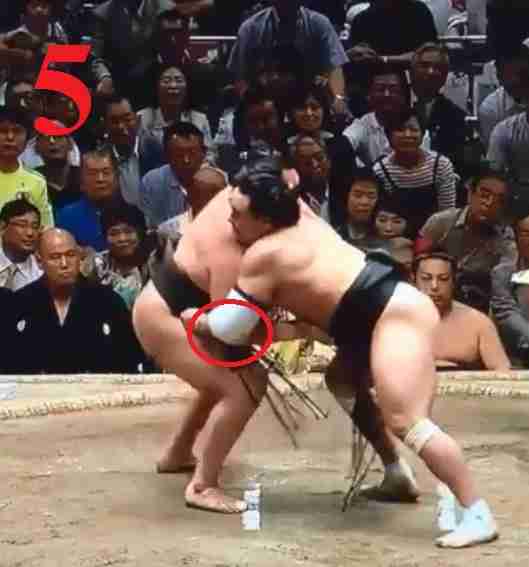
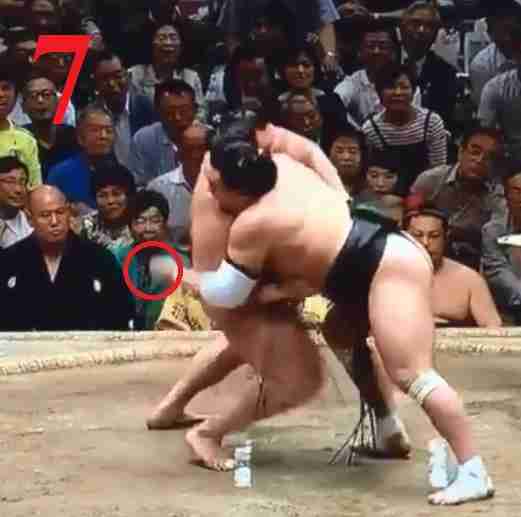
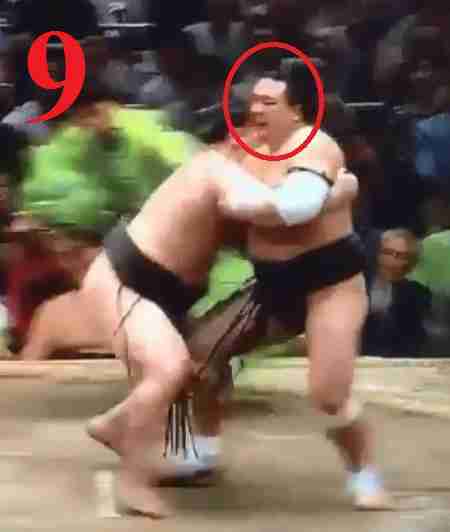
The way Hakuho broke Harumafuji's left handed grip is the stuff of textbooks. 1) This is the moment before the magic move. 2) Hakuho lets go of his right-handed inside grip. Required for next move. 3) He anchors the freed hand on Harumafuji's belly. Required for next move. 4) He moves his right leg forward. Required for next move. 5) He rests his right elbow on his thigh. Hakuho's right hand is so firmly anchored to Harumafuji's belly because of the elbow being pushed by the thigh that it actually moves Harumafuji back a few inches. Required for next move. 6) He moves his hips lower and to the right until his right elbow starts pushing on Harumafuji's left arm. Required for next move. 7) He makes a lightning quick forward movement with his hips. Harumafuji's grip is broken because Hakuho's anchored elbow is blocking Harumafuji's left arm from following Hakuho's hips. 8) Instantaneously with the forward hip movement and the breaking of Harumafuji's left handed grip, Hakuho 'disassembles' his anchor mechanism and moves his right hand for a high inside hold to make it difficult for Harumafuji's left hand to get to Hakuho's mawashi again. 9) Hakuho starts the yori charge. Harumafuji knows he can't do anything about it and lets himself be pushed out.




- 803 replies
-
- 22
-

